
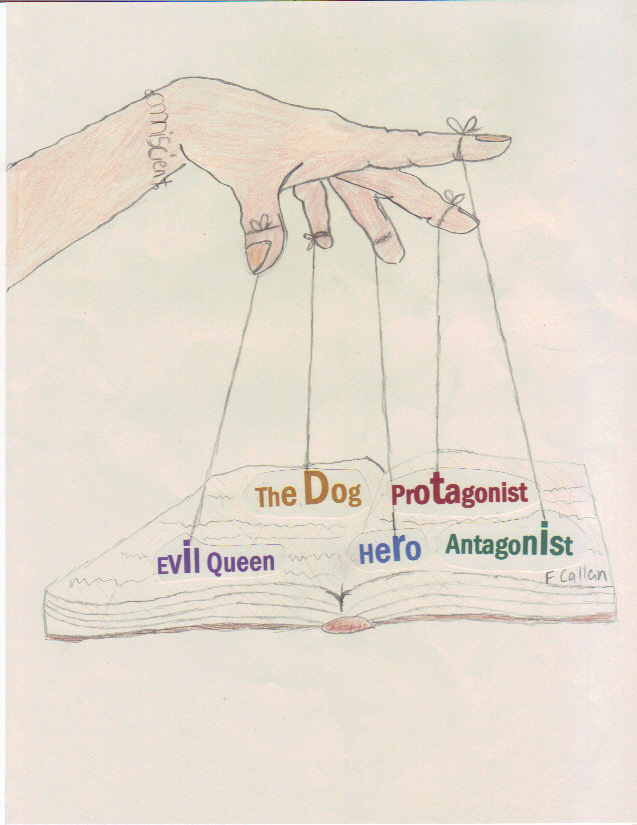
 To continue my series on the point of point of view lets take a look at the use of the third person omniscient POV. In previous posts we discussed the pros and cons of using the first person, now lets consider the use of third person.
There are multiple types of third person POV including:
- Third Person Limited (or Subjective)
- Multiple Third Person Limited
- Third Person Omniscient
**Note: There’s also Third Person Objective or Dramatic POV. But I’m going to talk about that later in another post.
Were going to focus on the omniscient POV for this post, which is when the author is “God-like” and can see everything that is happening and is no longer limited to the POV of a single character. Some distinct advantages to this type of point-of-view include:
Five Advantages of the 3rd Person Omniscient POV:
1) It’s Traditional – Once upon a time there was a… Most of the stories we were told as children were created in a third person point of view. There was a narrator and he/she told the story. Therefore it seems very natural to hear a story told in the third person. It harkens back to our deepest concepts of storytelling.
 2) Getting to Know Multiple Characters – Third Person Omniscient POV allows the author the freedom to get out of the “claustrophobia” of a single POV and expand our scope. An omniscient POV is able to get inside the minds of multiple characters and delve deeper into emotions and relationships. We move away from a limited filter of a story (remember everyone will tell the events of a story differently) and are able to see how multiple characters react/interpret the events. John Gardner (an advocate for the omniscient POV) says: “In the authorial omniscient, the writer speaks as, in effect, God. He sees into all his characters’ hearts and minds, presents all positions with justice and detachment, occasionally dips into the third person subjective to give the reader an immediate sense of why the character feels as he does, but reserves to himself the right to judge.” (The Art of Fiction).
 3) Authorial Voice – One of the draw backs of first person POV is that the voice of the text is the voice of the character. Using the third person, however, allows the authors voice to take the front seat. Marion Dane Bauer says: “There are no limits to your language in third person. You can write about a three-year-old or about a lion in your own language, not theirs. You don’t have to make your story sound as though someone other than you is telling it.” (What’s Your Story?). In effect, the narrator’s voice becomes the voice of the story. The author now has more freedom in crafting that narrative voice.
4) Epic Storytelling – Omniscience seems a natural choice for stories of an epic nature. If you are telling a story with lots of characters, that spans many years, covers many lands/areas, the omniscient POV is going to be your friend. Limited POV (first person, third limited/subjective) is — well — limiting. Gardner states that other points of view “achieve little grandeur” outside of the omniscient POV. Limited perspectives only allow for certain threads of a story to be told, and from particular filters and opinions. An omniscient POV can broaden the scope of a story. It’s perfect for grand and fantastical adventures like The Lord of the Rings.
5) Action! Action! Action! – The third person really helps the writer to get into the action. The third person creates more distance from the character and his/her thoughts. Therefore the writer can focus on the actions of the character. First person POV can become a bit of a “tell-fest” (tell, tell, tell), but third person really puts the action back into the scenes. If you struggle with showing instead of telling, maybe changing up the POV could help. Marion Dane Bauer agrees in her book What’s Your Story wherein she states: “In the third person, most writers, even beginning writers, have little difficulty moving directly into action.”
Do you write in the third person omniscient? Why? Are there other advantages that you’ve found? Or have you avoided the omniscient POV? I’d love to hear your thoughts!
Works Cited:
Bauer, Marion Dane. What’s Your Story: A Young Person’s Guide to Writing Fiction. New York: Clarion Books, 1992. Print.
Gardner, John. The Art of Fiction. New York:Vintage Books, 1983. Print.
 Ingrid's Notes
I typically write in 3rd person limited although I do like 3rd person omniscient. Sometimes I like to experiment in 1st person and someday I want to try 2nd (so hard to do!).
This is great to know. I’m an action writer and usually write in 3rd. I’ve been considering switching to 1st to go with the YA trend where almost everything seems to be in first these days. Now, I may stay in 3rd…or not. Ack! It’s a hard decision.
Interesting series. I write in 3rd person limited. I’ll be curious to hear what you say. I’m glad to see others do too.
What is third person limited
Third person limited is when you are only in the mind of one character, but you are not in first person using the pronoun “I” you are using third person pronouns of “She, her, etc.”
I’m really enjoying your POV series, Ingrid. Good to see the pros and cons.
This is the most helpful explaination I have ever read. Thanks so much for posting this!
Pingback: First vs. Third | Among Dahlias
The biggest drawback of third person omniscient is that readers can get confused if the author can’t smoothly move the reader from one point of view to another. It is possible to get mental whiplash when the author is head-hopping. Since I already have problems with normal transitions through time and space, I’ve avoided the POV transition. But if the right story comes along…
Write now, my novel is in First Person with Multiple narrators. One irritating thing about it is that I can’t write exactly what I want – for example, one of the narrators is a teenager, rather sporty and doesn’t enjoy school.
Normally I would use words which – let’s just call them ‘Big’ words, but for this character, I can’t. On the other hand, that is one of the interesting things about it – another narrator is a high political figure, and when you compare the narrators, it’s quite interesting!
Hi Ingrid
Great post. I am a creative writing student coming to terms with many aspects of writing including pov. I am particularly interested in techniques for making transitions from one character to another in 3rd person omniscient. I will be linking to this post on my blog.
Thanks for posting this helped me x100.
Wow – I’m late to this discussion, but thank you for this blog. I am writing a book in omniscient POV and am getting constantly told about my POV with several of my critiquers. Others have figured out which POV I’m in and like the story. It’s an experiment. 3 person limited is exactly that after a while – limited.
I have said it before and I’ll say it again, it isn’t so much WHICH point of view you use, as WHY you choose to use it.
I am on a final edit of a slightly long, rather epic science fiction novel spanning two different civilizations who live a million years apart. I typically rely on third person limited, with omniscience used judiciously for cinematic lead ins and occasional explication.
I was just editing a pivotal scene in which two characters, one of whom is the rather tortured lead, are beginning a relationship, and I realized that I have allowed the POV to move between them several times within a single scene. “Why did I do that?” I wondered, until I reached one of the latter paragraphs in which I describe both of their feelings, God like, at once.
Both of these characters are careening through their separate lives–paths that cross HERE in this scene. If this were a romance, I might split these feelings across several chapters, but what I have done is used shifting POV to convey romantic action. Whether these characters will fall in love is not meant to be a mystery–only whether the lead will admit his feelings, or break the girls heart in an attempt to protect her–a question that ties his relationship with her back to his own past. In shifting between their minds eyes in this way, I effectively convey their emotional conjunction. This is no different, in a literary sense, from letting the perspective bounce around a battlefield to convey the sweeping action as it crashed upon a particular character.
So, is “head hopping” always wrong? I do not think so. I think sometimes an author NEEDS to unsettle the reader a little. It all depends on WHY it is done.
C. Stuart – I agree, choices in POV do rely on why they are done and the effects created, and if they work. If the effect draws attention to itself and pulls the reader out of the fictive dream (like if you switch POV mid-novel) it can be a problem, however. It’s all a very tricky and delicate balance. I don’t think “head hopping” is ALWAYS wrong. If done well it can work.
But is the shifting back and forth effective? It might be. I’d give the scene to five or six readers that I trusted to see what they think.
Fantastic! I always wonder if third person or first person help me much in writing a story. Now, I get it
This really helped with an assignment! Cheers 🙂
I write in omniscient, but people are always like “bad head hopping!” It’s annoying, but in this fantasy series I’m starting on, I’m going to stick to it, because there’s a whole heap of main characters (six, at least, maybe more) and I think omniscient is best for the grand scale that it’s going to be written as.
Daniel,
Omniscient is really hard to pull off! It’s also “out of vogue” right now. But that doesn’t mean it isn’t the right POV for your novel. Follow your instincts. You know how to tell your story better than anyone. “Bad head hopping” is simply a matter of practice, working on developing the skill, and nailing it!
I thought that might be the case: that they’re really commenting on the way I do so, more than it being wrong to do so. That, or my writers group is really just a bunch of trend-following sheep…
Hi Ingrid,
I would like to create a fictionalized character based loosely upon real events. I want to do this in a way that may show what it’s like be a love addict. However, I want to go against the trending “1st person POV” (i.e. Confessions of a …. Dear Diary…Go Ask Alice…etc.) type of journal-like entry. Even though it is a journal~ a series of adventures, I want to play around with the 3rd person omniscient POV since, like you’ve mentioned, it is 1) Traditional (I want to play on the concept of The Love Story) and 2) It forces the narrator to see the characters in multiple perspectives, it forces the writer to be more Show than Tell, and 3) It empowers the narrator’s authority.
However, what are some of the limitations of the 3rd POV if one is attempting to write in a way that could still reveal the most intimate feelings of a character? Is this possible? Do you recommend a particular type of book that focuses on the 3rd Person Omniscient craft?
This was a really great blog post – I struggle with POV at times and find I usually start a book in first person and invariably end up changing it back to third about fifty pages in. Much stronger angle at times.
In my book, Inside Dweller, third person omniscient was almost an organic choice for me. In Inside Dweller, it’s a story about a woman who experiences a host of mysterious problems with unknown causes. Sometimes, she is able to deal with them. Sometimes, she loses consciousness. For those down times, the story needed to continue as her loved ones and her psychologist help her discover the source of these problems and the mysterious presence that seem to be stalking her. So far, I’ve been able to obtain a small publisher who has promised to print the book, but is giving me the latitude this year to see if there is a larger publishing house with wider distribution. I also have gained an agent, all with a story using the omniscient third person POV. Lots of people knock it, but for this tale, it was the only way I found it could work. You just have to make sure that each character has a distinct voice so there isn’t any confusion on whose head you’re in, and to keep it consistent with the action of the story. I love stories with a strong point of view, because there’s entertainment in learning one point of view so well, and sometimes the person’s limitations are such good opportunities for comedic relief. I think the most helpful way to determine whether or not to use the omniscient third person is to determine whose story you are telling? Is it her story, his story, or their story? if it’s their story, the omniscient POV might be for you. I struggled so much with POV, so much so it created writer’s block for two decades. It’s funny that I have found comfort in a POV that is so often knocked.
I so agree. Is it his story? Hers? Theirs? If it’s theirs – which is what most romances are – a 2 person story – why is everyone so determined that the story be told from one POV – or from one POV at a time?
I gave up and indie pubbed under a pen name because I kept being told “you can’t write it in Omni.”
I’m having trouble with the cookie cutter mentality that the publishing industry seems to have. I hope publishers don’t give me a problem with the omni, because it was essential to make the plot move along. I just have a problem believing that a reader will set there, read a book and say, gee, this is in omniscient third person, I can’t read this!
Kirsten, it’s all about execution. If you do it well, no one will care or complain! 🙂
That’s true. Thanks.
If someone claims that they can’t read it – they’re crazy – stories have been written in this form for a long time. It’s only been since the 1990’s that “rules” of writing clamped down to – you can’t do this – you can’t do this.
Amen to that.
I have been surfing on-line more than three hours lately,
but I by no means discovered any fascinating article like
yours. It’s lovely worth enough for me. In my view, if all website owners
and bloggers made excellent content as you did, the
net will be a lot more useful than ever before.
Your article is a wonderful blessing. I have (or had) no idea of my POV and continually wondered if my writing was somehow wrong. It must be noted that I have a posse of head hopping police in pursuit as we speak. Struggling to meet a confusing POV standard almost took the joy out of going on these marvelous epic adventures with my characters. Now I have an answer.
In the dusty confines of my scrambled mind and cluttered writing desk I am Omniscient! Bend thy knee and hear the wonders of the worlds that my mind conjures.
Hi Bill! I’m so glad you found this helpful! Keep writing!
I have one story that is first person narrative and one YA novel with lots of characters that is omniscient. I love being able to show what each character is up to for giving a wider world building experience. But sometimes I have a hard tine keeping thr POV and my editor catches me. It is easy to get carried away and forget whose perspective you’re sharing, I find.
Great blog post, glad I found it on GPlus 🙂
Obtrusive omniscient narration, similar to that of Herman Melville in Pierre is my one true way to go. No diatribes by the show don’t tell fascists will be able to deter me therefrom.